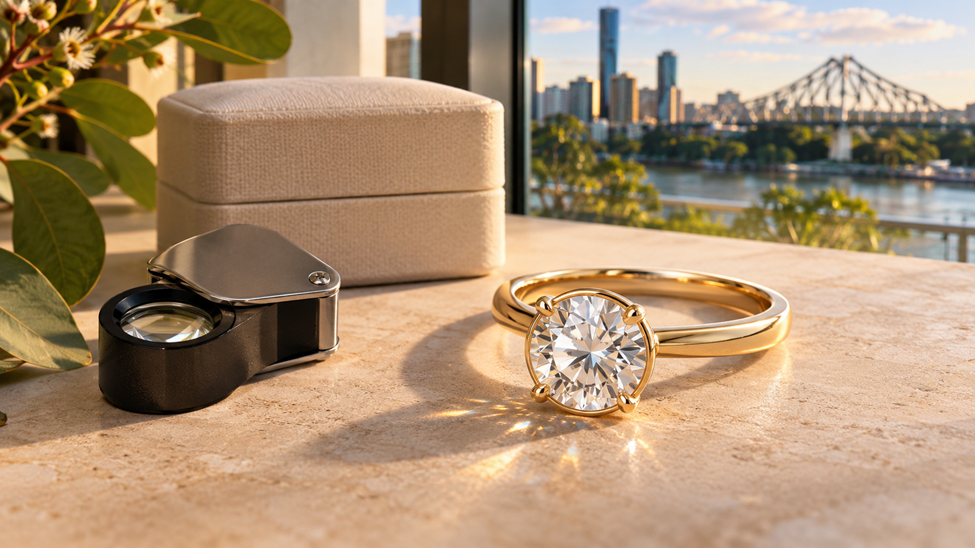
An engagement ring can look perfect under showroom lights and feel quite different after a week of typing, commuting and carrying shopping bags. For Brisbane couples comparing lab grown engagement rings, the useful questions go beyond how brightly a diamond sparkles. They include how the setting sits on a hand, what the grading paperwork means and whether the ring will be straightforward to maintain.
The diamond matters, of course. But a ring that is comfortable, well made and properly documented is easier to enjoy long after the proposal.
Start with the person who will wear it
Before choosing a carat weight, think about an ordinary day. Does the wearer work with their hands, wear gloves, play sport or prefer jewellery that barely catches on clothing? A tall setting may show more of a diamond from the side, but it may also be more noticeable during daily tasks.
Ask to try on different band widths and profiles. A narrow band might look delicate in a photograph, while a slightly wider one can feel more balanced on the finger. These are personal preferences rather than universal rules.
Ring size deserves the same attention. Fingers can change slightly with heat, activity and time of day. A jeweller can explain how the proposed band width and design may affect the fit, and which resizing options will remain available.
Know what a lab-grown diamond is
Laboratory-grown diamonds are diamonds produced through controlled manufacturing processes rather than geological formation. According to the Gemological Institute of America (GIA), they have essentially the same chemical composition, crystal structure and optical and physical properties as natural diamonds.
That does not mean every diamond looks identical. Cut quality, proportions, colour and clarity still influence appearance. Nor should lab-grown diamonds be confused with diamond simulants such as cubic zirconia or moissanite, which are different materials.
The origin should be clearly identified on the product description and supporting documentation. This is particularly important when comparing online listings that use similar-looking photographs and broad terms such as “created” or “ethical”.
Read the report rather than relying on a label
A grading or assessment document helps buyers understand what has been examined. Check the laboratory’s name, the report number, the stone’s measurements and its identification as laboratory-grown. If there is a laser inscription, ask the jeweller to show how it corresponds with the paperwork.
Do not assume every laboratory uses the same reporting system. From October 2025, GIA introduced an updated quality assessment for qualifying laboratory-grown diamonds, classifying them as Premium or Standard. Older GIA reports and reports from other laboratories may show familiar colour, clarity and cut grades instead.
A report is useful, but it does not replace looking at the actual stone. Ask to compare diamonds in daylight or neutral lighting if the retailer can accommodate this. An attractive photograph tells you less about how a diamond looks in motion, especially in elongated shapes where the pattern of light and dark areas can vary.
The setting is where daily comfort is decided
It is easy to concentrate on the centre stone and overlook the metal surrounding it. Yet the setting determines how high a ring sits, how exposed the edges of the diamond are and how easily the piece catches on fabric.
Prongs, bezels and practical compromises
Prong settings leave more of a stone visible. A bezel surrounds more of its edge with metal and can offer a smoother outline. Neither design is automatically right for everyone; construction quality and the wearer’s habits matter more than a fashionable label.
Pointed shapes such as pear and marquise diamonds need particular attention at their tips. Ask how those vulnerable areas are protected. For rings with tiny accent stones, find out how the retailer handles inspections and repairs if a setting becomes loose.
Brisbane buyers can explore lab grown diamond rings Brisbane through retailers such as Novita Diamonds. The product photographs are only a starting point. It is worth asking to inspect a ring from the side and understand how the setting is constructed before making a decision.
Think about the wedding band now
An engagement ring may sit neatly on its own but leave an unexpected gap beside a straight wedding band. A raised setting, curved band or matching design can change how the pair looks and feels.
If a wedding band will be worn later, try the two together before committing. Check whether the bands rub against one another and whether the arrangement will be comfortable for everyday wear.
Ask what the final price includes
Two rings with similar-looking diamonds can have different prices because of their metal, construction, setting complexity, grading documentation and after-sales services. Compare the whole package rather than only the carat weight.
Before paying a deposit, clarify the metal purity, total quoted price in Australian dollars, expected delivery date and whether the ring is made to order. Ask about resizing, maintenance, manufacturing defects and what happens if the finished piece differs from the approved design.
Australian Consumer Law gives buyers guarantees that apply alongside a retailer’s own warranty terms. The ACCC explains that buyers may be entitled to remedies when goods fail to meet those guarantees. A change of mind, however, does not automatically entitle a customer to a refund. Keep the receipt, product description and any design approvals.
Also ask whether the ring’s value needs to be separately covered under home and contents insurance. Do not assume every policy automatically covers jewellery away from home or up to its full replacement cost.
Plan for care before the first scratch
Diamonds are hard, but an engagement ring is not indestructible. Metal can scratch, claws can wear and a sharp knock can damage a setting. Sunscreen, hand cream and everyday oils can also leave a film that makes the stone appear less lively.
For many diamond rings, gentle cleaning with warm water, mild soap and a soft brush is a sensible starting point. Check the jeweller’s instructions first, especially where the design contains other gemstones or has special treatments. Avoid bleach and abrasive household cleaners. If a stone feels loose, stop wearing the ring until a professional has inspected it.
A broader article on caring for lab grown diamonds and other jewellery discusses cleaning, separate storage, chemical exposure and regular checks. Those habits are helpful, but they cannot make up for a poorly designed setting.
The Jewellers Association of Australia recommends having jewellery checked and cleaned by a jeweller each year. A quick inspection can reveal wear around claws or small stones before a repair becomes more difficult. Store the ring separately when it is not being worn so harder surfaces do not rub against other pieces.
Be cautious with claims about value and sustainability
A laboratory-grown diamond can offer buyers a different choice of size and specifications for their budget. That does not make it a guaranteed investment. Prices for lab-grown diamonds have changed, and future resale value should not be assumed from the original retail price.
Environmental language also deserves scrutiny. Words such as “green”, “sustainable” or “carbon neutral” are not meaningful evidence on their own. The ACCC advises that environmental claims must be accurate and supported by reasonable grounds. If environmental impact matters to you, ask what a claim covers and what evidence supports it.
There is no need to settle the broader debate over mined and laboratory-grown diamonds to choose a ring. A clear description, realistic budget and honest answers from the seller are more useful than sweeping promises.
Take one last look before saying yes
Before collection or delivery, check the finished ring against the agreed design, confirm the paperwork matches the stone and inspect the setting closely. Keep photographs and invoices together, and find out who to contact for future resizing or repairs.
The best choice is not necessarily the largest diamond in the cabinet. It is the ring that suits the person wearing it, with a setting that makes sense for daily life and enough reliable information to buy with confidence.