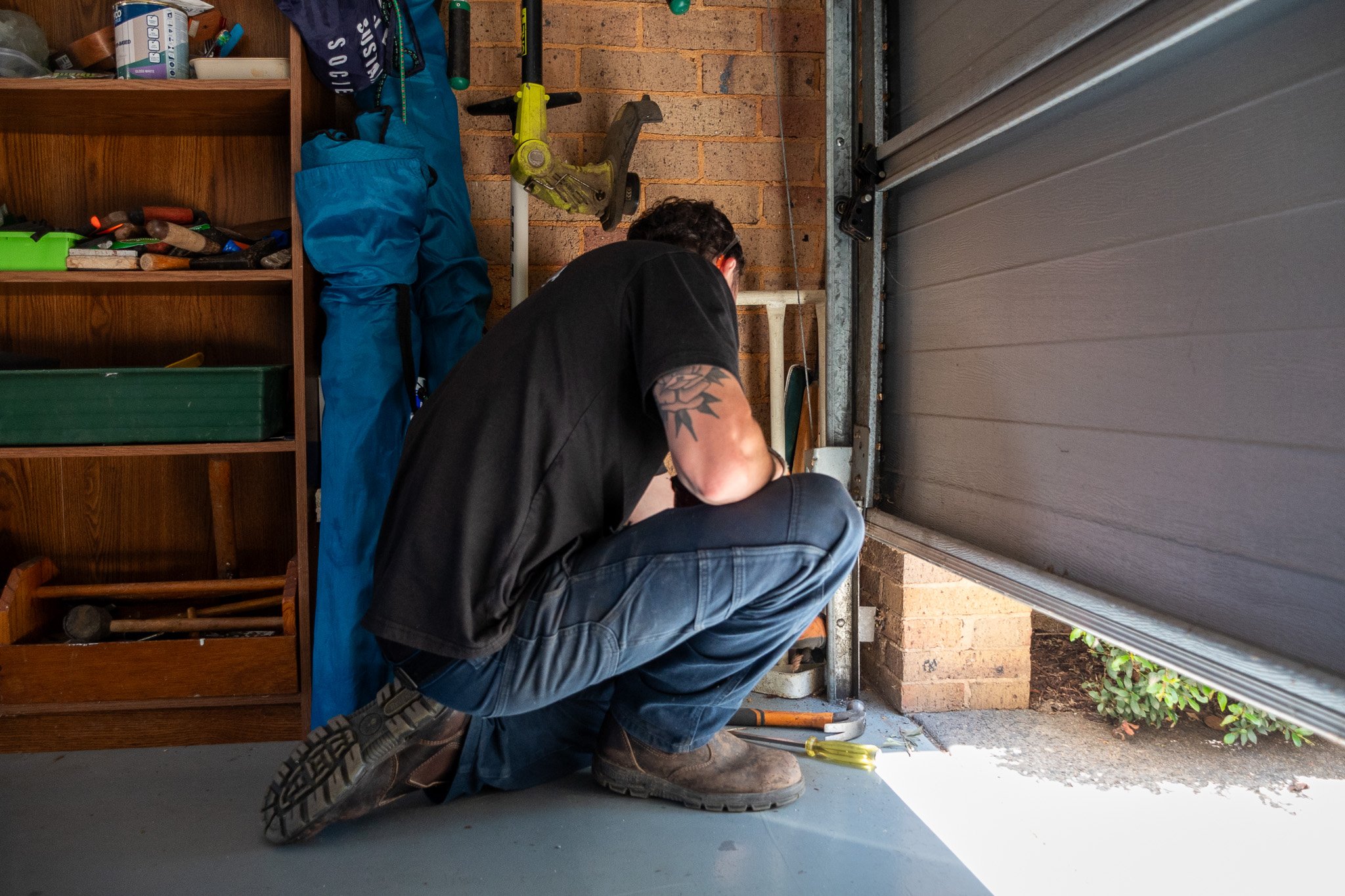
A garage door is the largest and heaviest moving object in most Brisbane homes. It is also the household machine most likely to be ignored until it fails, and the one most capable of causing a serious injury when it does.
Brisbane’s conditions do not help. Humidity, intense UV, driving rain, storm season and salt air across the bayside suburbs all work steadily on the same components. This guide covers what you can safely maintain yourself, what you must never touch, the warning signs that mean stop using the door, and how to check that whoever you call is legitimate.
Start With What Not to Touch
This section comes first deliberately, because a small number of components account for most DIY garage door injuries.
- Springs. Torsion and extension springs hold enough stored energy to counterbalance a door weighing well over a hundred kilograms. Winding, adjusting or replacing them requires correct winding bars and proper training. Improvised tools slip, and people lose fingers and worse.
- Lift cables. Under very high tension. If you can see fraying, broken strands or a cable off its drum, stop using the door.
- Bottom brackets on sectional doors, which remain under cable tension even with the door fully closed.
- Opener force and travel limit settings. Incorrect adjustment either damages the door or defeats the safety system that stops it closing on a person.
- Track realignment. A bent or misaligned track needs assessment, not persuasion.
- Any electrical work, which must be carried out by a licensed electrician in Queensland.
If the door is off balance, dropping, jerking or has made a loud bang, stop operating it entirely and call someone. A failed spring can allow a heavy door to come down fast.
Signs You Need a Technician Rather Than a Spanner
- A loud bang from the garage, which very often means a spring has broken.
- The door has become heavy to lift by hand, or will not hold its position.
- A visible gap in a spring coil, or a spring that looks stretched, rusted or distorted.
- Frayed, slack or derailed cables.
- The door is crooked, jamming, or sitting lower on one side.
- Auto-reverse or the safety sensors are not working.
- The opener runs but the door does not move, or it reverses for no apparent reason.
- Any storm or impact damage to panels, tracks or the frame.
In each of these cases, continuing to use the door risks making the damage worse or causing injury. Disconnect the opener, leave the door closed if you can safely do so, and arrange an inspection.
Checking That a Contractor Is Legitimate
In Queensland, building work above a prescribed value generally requires a licence from the Queensland Building and Construction Commission, and the threshold is low enough that many garage door jobs are captured.
- Ask for the QBCC licence number and verify it yourself through the QBCC licence search. It is free and takes a minute.
- Check the licence class covers the work quoted, not simply that a licence exists.
- Confirm public liability insurance and the sum insured.
- For hardwired openers, confirm a licensed electrician does the electrical work. Unlicensed electrical work is an offence in Queensland and will generally void your home insurance for any resulting damage.
- Get the business name and ABN in writing, and check they match the licence and the invoice.
- Ask whether the quote is fixed or an estimate, and what happens if additional work is found.
- Ask what warranty covers parts and what covers workmanship, since these are frequently different periods.
Among local operators, the Garage Door Specialists in Brisbane at Lightning Garage Door Solutions set out their position on these points — over ten years in the trade, vehicles stocked to complete most jobs in a single visit, a stated workmanship guarantee alongside product warranty, a no fix no pay policy, and 24/7 availability for urgent faults. They cover the greater Brisbane region from Narangba to Pimpama and Bayside across to Ipswich, and work with homeowners, real estate agencies, property managers and body corporates.
Whoever you engage, apply the same test: verify the licence independently, get inclusions and warranties in writing, and require a diagnosis before accepting any quote for full replacement.
Warning signs worth walking away from
- No licence number offered, or an evasive answer when asked
- Cash only, no invoice, or no business name on paperwork or vehicle
- A firm price quoted over the phone for a fault nobody has examined
- Pressure to replace the entire door before diagnosing the actual problem
- No written warranty on parts or labour
- Any suggestion that the auto-reverse or safety sensors be disabled to make a door work
That last point deserves emphasis. If anyone proposes defeating a safety feature as a fix, end the conversation. That function exists to stop a heavy door closing on a child.
The Monthly Five-Minute Check You Can Do Safely
All of the following is appropriate for a homeowner and catches most problems early.
- Watch and listen through a full cycle. Grinding, scraping, banging or any change in the usual sound is the earliest useful warning you get. So is jerky or uneven movement.
- Test the balance. With the door closed, pull the manual release to disengage the opener, lift the door by hand to about waist height and let go. A correctly balanced door stays roughly where you leave it. If it slams down or shoots up, the springs need professional attention.
- Test the auto-reverse. Lay a solid object such as a timber block flat on the floor in the door’s path and close the door. It should make contact and reverse. If it does not, stop using the opener.
- Test the safety sensors, where fitted, by breaking the beam with a broom handle as the door closes. It should stop and reverse.
- Confirm the manual release works, so you can open the door during a power outage.
- Look at the springs and cables without touching them. Rust, fraying or a gap in a coil all mean call someone.
- Check the weather seal along the bottom and sides, which in Brisbane keeps out driving rain, dust, geckos and vermin.
Re-engage the opener afterwards according to your model’s instructions.
Lubrication: Get the Product and the Targets Right
This is where well-intentioned maintenance frequently does harm.
| Component | Approach |
| Rollers, hinges, bearings | A purpose-made garage door lubricant, or a silicone or lithium-based spray, applied sparingly |
| Springs | A light coating helps resist corrosion — spray only, never handle or adjust |
| Tracks | Clean them; do not lubricate. Grease in a track collects grit and causes binding |
| Chain or screw drive | Per the manufacturer’s instructions; some are sealed and need nothing |
| Belt drive openers | Generally no lubrication of the belt |
| Nylon rollers and plastic parts | Check compatibility, as some products degrade plastics |
| What to avoid | General-purpose penetrating sprays are solvents rather than lubricants and can strip existing grease. Heavy grease attracts dust |
Wipe away any excess. Over-application attracts the fine dust that gets everywhere in a Queensland summer, which turns a lubricant into a grinding paste.
What Brisbane’s Climate Does to a Garage Door
- Humidity and rain drive corrosion on springs, cables, fixings and track hardware, particularly in poorly ventilated garages.
- Salt air in bayside and coastal suburbs accelerates that considerably. Rinsing the door and visible hardware with fresh water periodically genuinely extends component life.
- Intense UV degrades weather seals, plastic components, remote casings and paint finishes. Seals go hard and stop sealing.
- Heat affects opener electronics and can change how a door and its springs behave through the day.
- Storm winds and hail cause panel damage, track distortion and debris in the door path.
- Dust after dry spells builds up in tracks and on rollers.
- Termites, a genuine consideration for timber doors and frames in Queensland. Include them in your general property termite management rather than treating the door in isolation.
On new doors, wind loading is worth raising with the installer. Brisbane is not in the cyclonic region, but it does see severe storm winds, and a door rated for a sheltered inland site may not suit an exposed one. Ask what rating is being supplied and why.
A Seasonal Schedule That Fits the Local Year
- Before storm season, through spring. The most important check of the year. clear the door path, inspect seals, test the balance, confirm the manual release works, and get any noise or hesitation diagnosed before demand across the trade peaks.
- Through summer. Watch for heat-related opener faults, keep tracks clear of dust, and rinse salt exposure off if you are near the bay.
- After any severe storm. Inspect for panel dents, track distortion and debris before operating the door. Never force a damaged door.
- Autumn and winter. A good window for the annual professional service, since the trade is less stretched than immediately after a hailstorm.
- Annually, whatever the season. A full professional service. Most manufacturers and installers recommend yearly servicing, and more often for heavily used doors.
What an Annual Professional Service Adds
The homeowner checks above catch symptoms. A professional service addresses what you cannot safely assess yourself: measuring and adjusting spring tension and door balance, assessing remaining spring cycle life, inspecting cables and drums, correcting track alignment, setting opener force and travel limits properly, and torquing hardware to specification.
Scheduling garage door maintenance in brisbane on an annual cycle is also the point at which a spring nearing the end of its life gets replaced on a planned visit rather than failing on a Monday morning with the car shut inside. Lightning Garage Door Solutions recommend yearly servicing and offer a reminder when yours is due, which removes the main reason people skip it — forgetting.
Ask any provider what their service includes. Expect balance testing, safety system testing and spring assessment on the list. A visit that amounts to lubrication alone is not a service.
Storm Damage and Insurance
Severe storms are the busiest period for the whole trade, so a little preparation helps. If your door is damaged: do not attempt to force or operate it, since a bent track or failed spring can cause it to fall; photograph the damage before anything is moved or repaired, for your insurer; secure the opening if you can safely do so; and keep the itemised invoice and any written assessment, which insurers generally require.
If the door is stuck open, say so when you call. Security becomes the priority and it affects how a technician triages the job.
Your Rights Under Australian Consumer Law
Consumer guarantees apply to both goods and services in Australia, separately from any manufacturer or trader warranty. Services must be provided with due care and skill and be fit for the purpose you made known; goods must be of acceptable quality.
Practically: keep the written quote, the itemised invoice and the warranty documentation. If work proves defective, raise it in writing with the trader first, setting out what you want done. Queensland has consumer dispute processes if that does not resolve matters, and the QBCC operates its own complaint pathway for licensed building work.
Frequently Asked Questions
Can I replace a garage door spring myself?
It is strongly inadvisable. Springs hold very high stored energy and require specific winding tools and technique. Serious injuries occur regularly in DIY spring attempts.
How often should a garage door be serviced in Brisbane?
Annually for most homes, and more often for heavily used doors, multi-vehicle households, or doors in bayside suburbs where salt exposure accelerates corrosion.
Can I lubricate the tracks?
No. Clean the tracks but do not lubricate them, because grease holds grit and causes binding. Lubricate rollers, hinges and bearings instead.
Is a general-purpose spray suitable?
Common penetrating sprays are solvents rather than lubricants and can strip existing grease. Use a purpose-made garage door lubricant, or a silicone or lithium-based product.
Do I need a licensed contractor for a garage door repair?
In Queensland, building work above a prescribed value generally requires a QBCC licence, and the threshold captures many garage door jobs. Electrical work requires a licensed electrician regardless. Ask for the number and verify it through the QBCC licence search.
Should I repair or replace an older door?
It depends on the condition of the panels, tracks and frame rather than age alone. Expect a diagnosis of the specific fault and both options costed. An immediate replacement recommendation without diagnosis is a reason for a second quote.
The Bottom Line
Leave springs, cables, bottom brackets, opener force settings and electrical work alone. Those are what cause the injuries.
Do the five-minute monthly check instead: listen through a cycle, test the balance by hand with the opener disengaged, test the auto-reverse with an object on the floor, and confirm the manual release works. Lubricate rollers, hinges and bearings, clean the tracks, and never lubricate a track.
When you do need someone, verify the QBCC licence number yourself, get inclusions and both warranties in writing, and walk away from anyone who suggests disabling a safety feature. Then work with the local climate: make the pre-storm-season check the important one, rinse salt off if you are near the bay, and book the annual service in the quieter months rather than in the queue after a hailstorm.